

Engineering Design and Retrofit of an API Plan 53B Seal Support System for a Hydrocarbon Transfer Pump
- Home
- Lq-project
- API Seal Plan 58B Retrofit for an Industrial Process Pump
project details
Let’s Start Work
Together
Please feel free to contact us. We will get back to you with 1-2 business days. Or just call us now.
About Project
The project involved the engineering assessment and retrofit of an existing hydrocarbon transfer pump that had experienced recurring mechanical-seal leakage, unstable seal-chamber conditions, and premature seal-component deterioration.
Solcrest developed a pressurized dual-seal solution incorporating an API Plan 53B barrier-fluid support system. The arrangement was designed to maintain a clean and controlled fluid environment between the inboard and outboard mechanical seals while providing a pressure level higher than the pump’s seal-chamber pressure.
The project included site investigation, operating-data validation, mechanical-seal selection, pressure and thermal review, seal-support system design, instrumentation specification, preparation of engineering documents, fabrication coordination, installation supervision, testing, commissioning, and turnover.
Our Client’s Challenge
The existing pump was originally equipped with a conventional single mechanical seal that was no longer suitable for the actual operating conditions of the facility.
Variations in discharge pressure, intermittent pump operation, product contamination, and dry-running exposure contributed to recurring leakage and shortened mechanical-seal life. Repeated seal replacement resulted in unplanned shutdowns, maintenance costs, product losses, and increased safety and environmental risks.
The client required a more reliable sealing arrangement that could:
- Improve containment of the transferred hydrocarbon product
- Reduce visible leakage and fugitive emissions
- Protect the seal faces from contaminated process fluid
- Maintain stable lubrication and cooling around the seal faces
- Provide early indication of abnormal seal-system pressure
- Allow maintenance personnel to monitor system condition
- Minimize unplanned pump shutdowns
The retrofit also needed to fit within the available pump-base and piping clearances without requiring complete replacement of the existing pump.
Our Approach and Solution
Solcrest conducted a detailed assessment of the pump, mechanical seal, shaft dimensions, seal chamber, operating pressure, temperature, product characteristics, and available installation space.
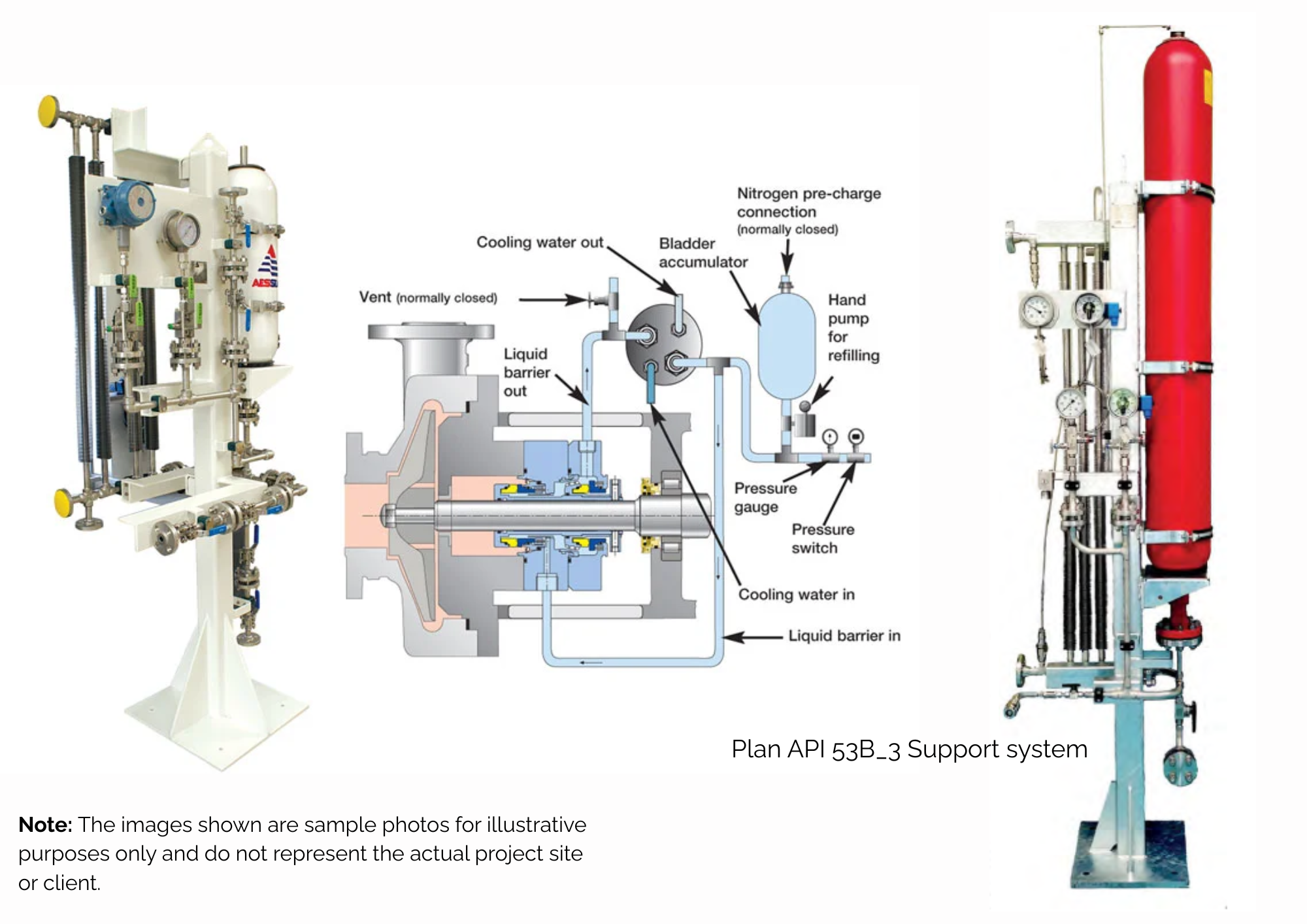
The existing single-seal arrangement was replaced with a dual pressurized cartridge mechanical seal connected to a closed-loop API Plan 53B barrier-fluid system.
The support system incorporated a nitrogen-precharged bladder accumulator to maintain barrier-fluid pressure without allowing direct contact between the nitrogen charge and the barrier fluid. A pumping ring within the mechanical-seal assembly circulated the barrier fluid through the seal chamber and external cooling loop.
The engineering and project scope included:
- Review of pump operating and maintenance history
- Verification of pump and seal-chamber dimensions
- Assessment of process pressure and temperature
- Assessment of process pressure and temperature
- Determination of required barrier-fluid operating pressure
- Thermal review of the seal-support circulation loop
- Selection of the bladder accumulator and air cooler
- Specification of compatible barrier fluid
- Development of the piping and instrumentation diagram
- Preparation of general arrangement and fabrication drawings
- Preparation of material specifications and bill of quantities
- Fabrication of the seal-support mounting frame
- Installation of stainless-steel tubing and isolation valves
- Installation of pressure and temperature instruments
- Modification of the pump seal chamber where required
- Precision alignment of the pump and motor
- Nitrogen precharging of the bladder accumulator
- Filling, venting and pressure testing of the circulation loop
- Leak testing and pre-commissioning inspection
- Controlled pump start-up and operational testing
- Verification of barrier pressure, temperature and vibration
- Preparation of commissioning and maintenance records
The barrier-fluid pressure was established above the maximum anticipated seal-chamber pressure to prevent process fluid from entering the seal interface. The system was also provided with local instrumentation and alarm provisions to help operators identify pressure loss or abnormal operating conditions.
Project Outcome
The retrofitted pump was successfully returned to service following mechanical installation, pressure testing, alignment verification, and controlled commissioning.
The API Plan 53B arrangement maintained stable barrier-fluid pressure throughout the operational test. No visible process leakage was observed during commissioning, and the pump operated within acceptable pressure, temperature, motor-current, and vibration conditions.
The completed retrofit provided the facility with:
- Improved containment of hydrocarbon products
- More stable mechanical-seal operating conditions
- Reduced risk of process-fluid entry into the seal faces
- Improved protection against premature seal failure
- Easier monitoring of seal-support system condition
- A maintainable and documented sealing-system arrangement
The project demonstrated how a properly engineered seal-support retrofit can improve the reliability of an existing pump without requiring full equipment replacement.